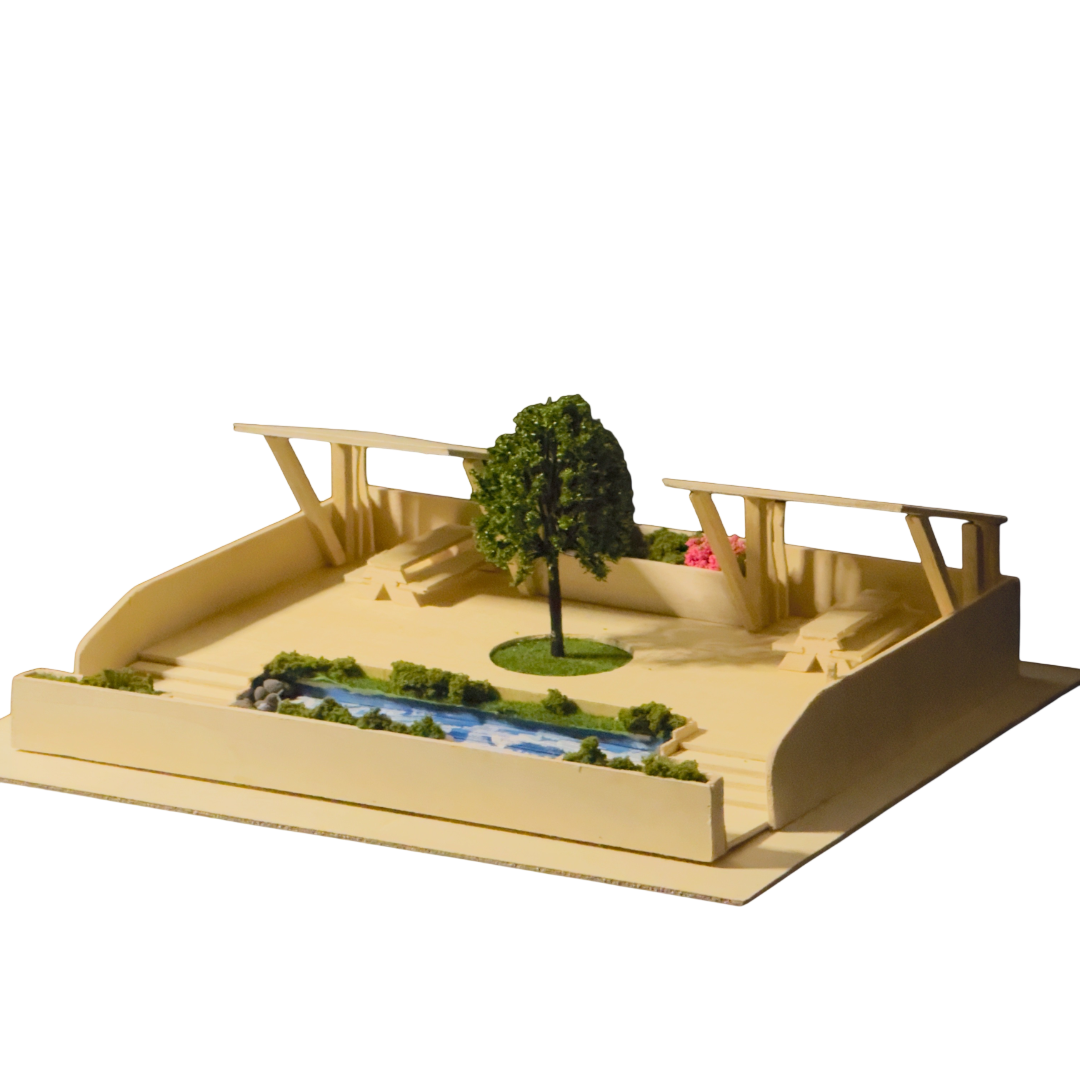
A public pavilion organized across two elevation zones — a lower walkway path and a raised gathering level above it. The grade change is the central design decision: it separates two distinct spaces that feel independent even when both are in use, distributing occupancy without enclosing either zone.
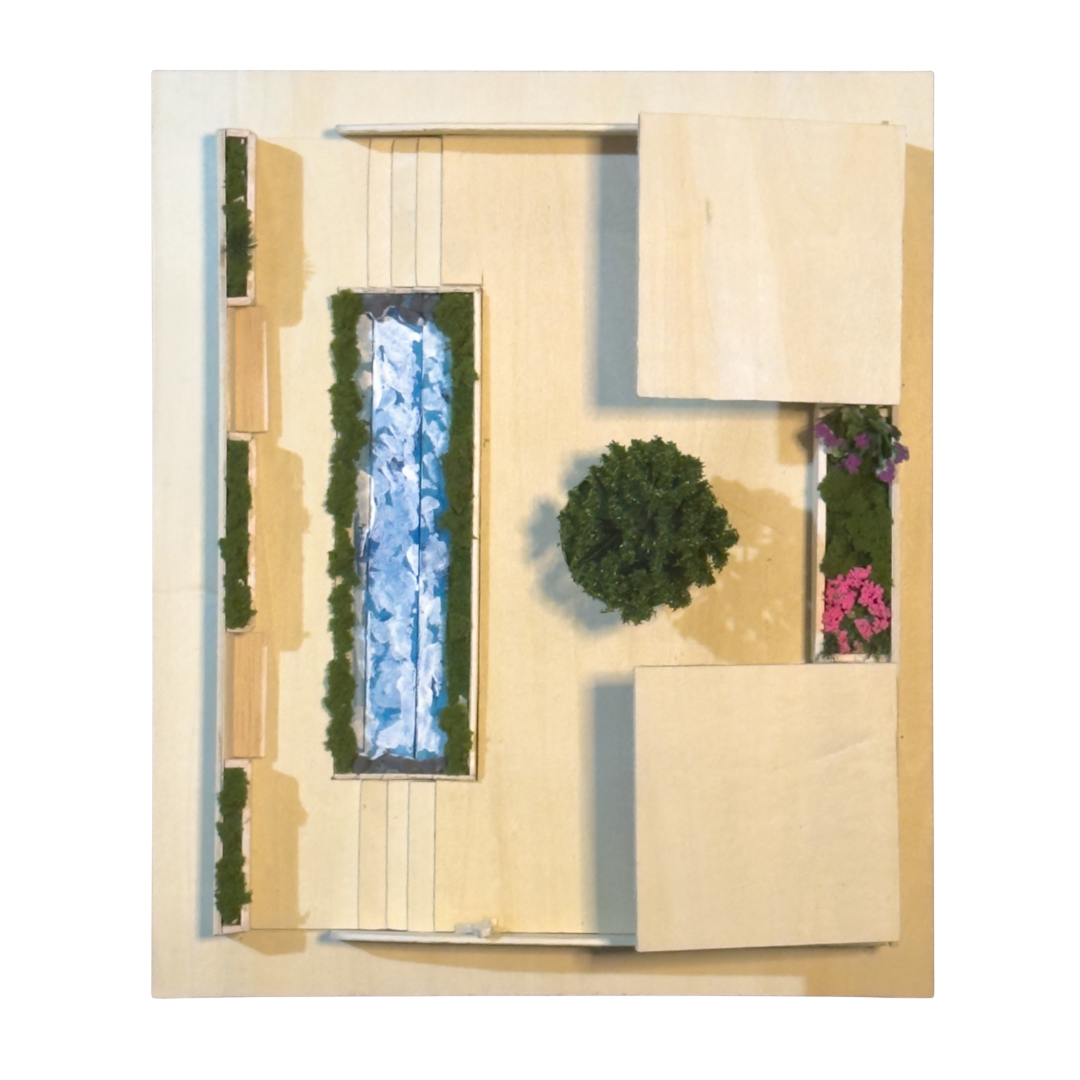
The site spans 56′ × 48′ and is divided into two zones by a terraced grade change. The lower level handles movement — a circulation path routed to disperse foot traffic rather than concentrate it, with planting beds along the retaining walls ensuring greenery stays within sightline regardless of where a visitor is standing.
The upper pavilion level is the gathering space: sheltered, quieter, and deliberately unassigned. No fixed seating arrangement, no prescribed use. Two covered pergolas flank the central zone, each with a sloped roof pitched outward so rainfall drains to the perimeter rather than onto visitors below.
The exterior retaining walls serve a secondary function beyond holding the grade: their mass and continuity act as acoustic barriers, reducing ambient noise from the surrounding site and pulling the interior into a quieter register. Inside the walls, the pavilion reads as its own place rather than an open clearing.
The angled canopy roofs are a direct response to a common failure in covered outdoor structures — water pooling above and finding its way through. Here the pitch faces outward, away from the occupied zone, so the drainage path is never over a visitor’s head.
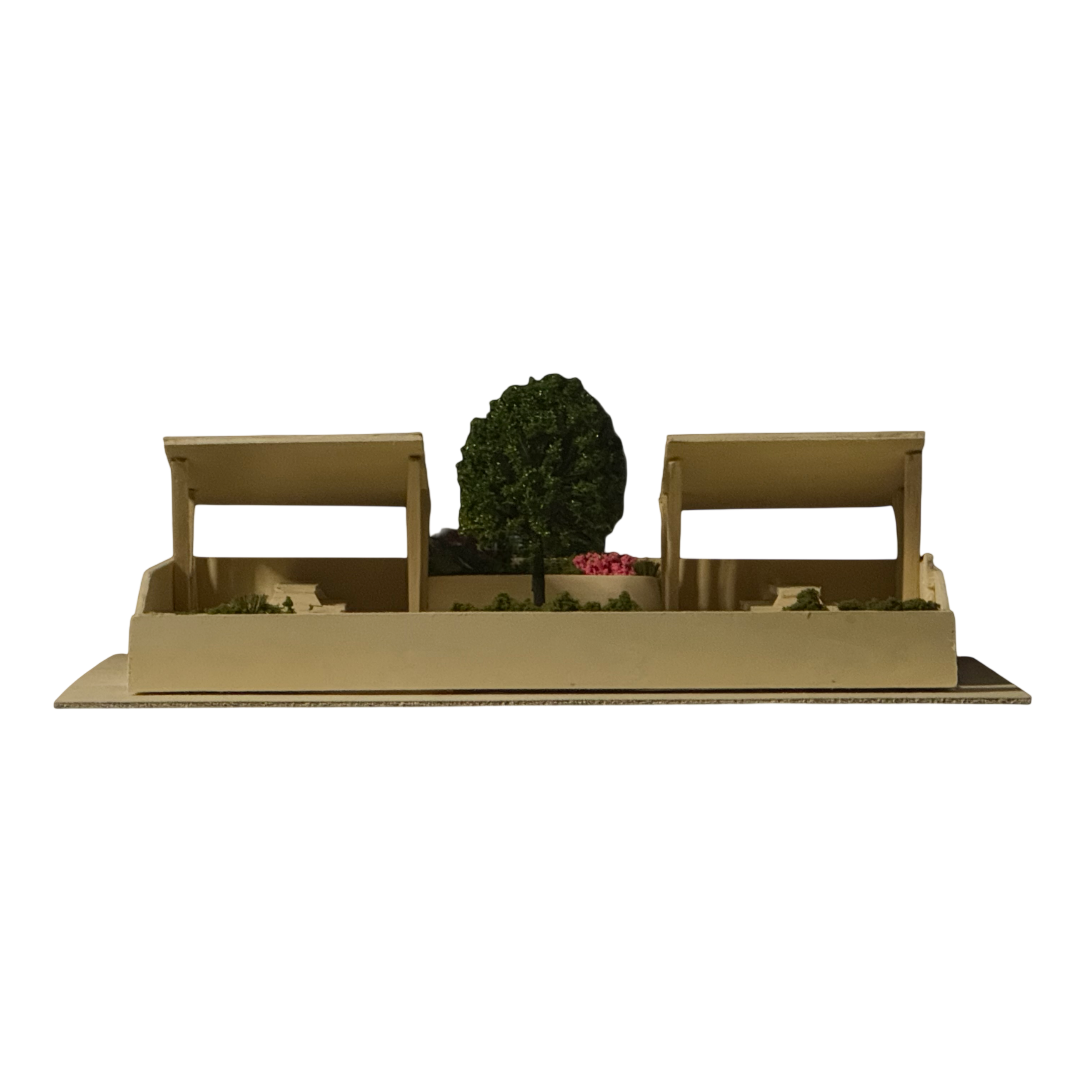
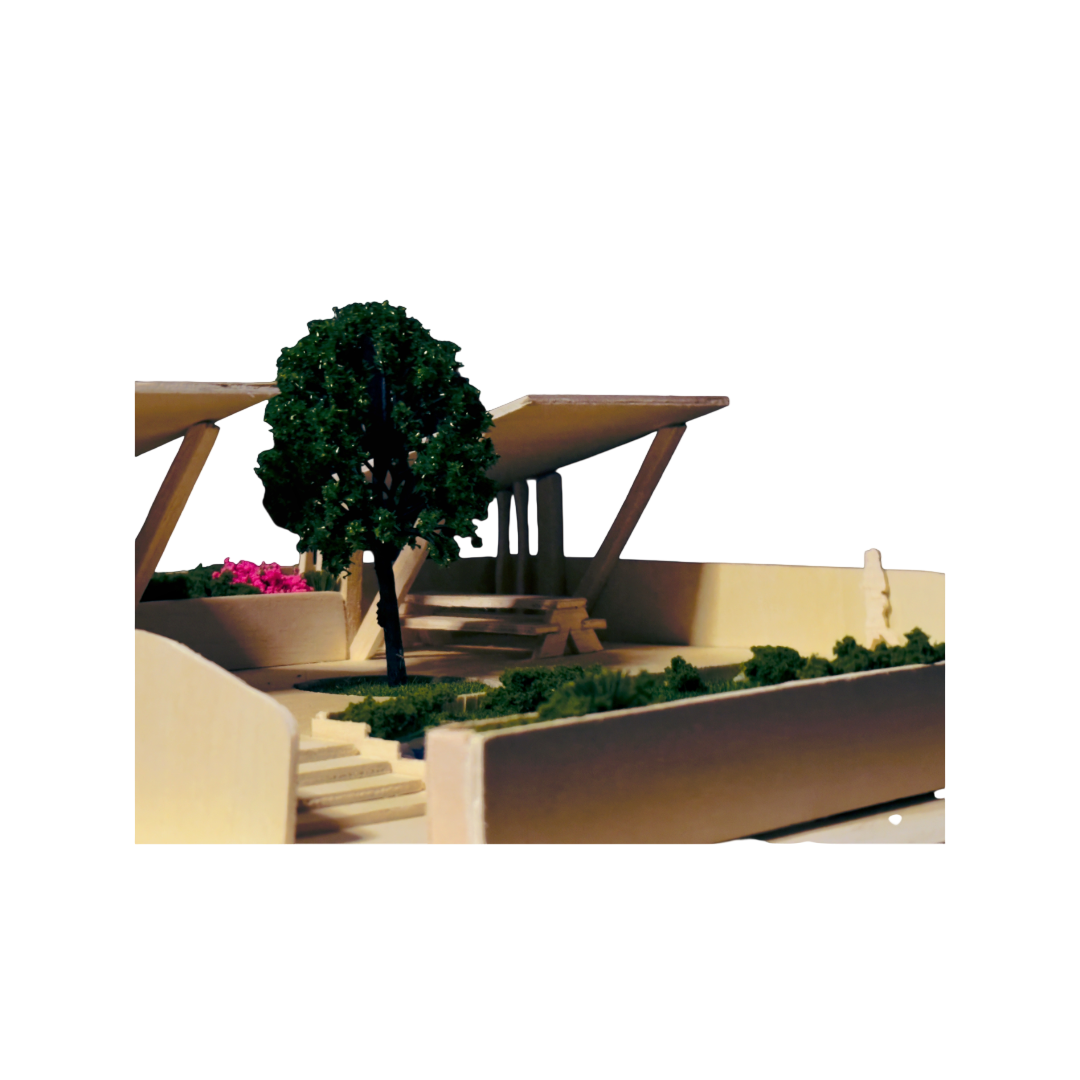
Ground-level view from the lower path — the canopy edge, grade change, and central tree visible simultaneously.
At the center of the upper level, a recirculating system connects a reflecting pool, a small waterfall, and a wishing well in a single closed loop. The waterfall provides the drop height and the sound; the well gives visitors a reason to engage with it directly. Benches face the feature — a deliberate choice to create a pause point rather than another pass-through.
Every decision in this project — the grade separation, the circulation routing, the wall mass, the roof pitch, the water loop — resolves more than one problem at once. That’s the standard the design was held to.
Design a public outdoor space applying Kevin Lynch’s five-element framework — paths, edges, districts, nodes, and landmarks — as the organizing principle.
1.5mm basswood, Vallejo water texture, model vegetation. Floor plan and section elevation drawn in AutoCAD. Scale: ¼″ = 1′.
Design Theory I · Eastern Michigan University · Presented at the 46th Annual Undergraduate Symposium, March 2026. Faculty: Dr. Hanan Hashaykeh.